50 Anniversary of Dr. Martin Luther King Assassination
When we think about the legacy of the great civil rights leader the Rev. Dr. Martin Luther King, Jr. people should think about how his efforts went towards making this world a better place. King did not only utter words, but he led by his actions. It was in the late 1950’s a young Alabama minister answered the call about an NCAACP secretary who was jailed for not giving up her seat because she was tired from working all day.
Furthermore, his ministry was based on those principles of faith, hope, and love. He fought for equality for all people by using nonviolent peaceful protest and truly was a drum major for justice.
Dr. King was born on January 15, 1929, at the family home in Atlanta, Martin Luther King, Jr. was the first son and second child born to the Reverend Martin Luther King, Sr. and Alberta Williams King. In addition, born to the Kings were first-born Christine, now Mrs. Isaac Farris, Sr., and the King’s third child Reverend Alfred Daniel Williams King, who is now deceased.
Martin Luther King, Jr.’s maternal grandparents were the Reverend Adam Daniel Williams, second pastor of Ebenezer Baptist Church, and Jenny Parks Williams. His paternal grandparents were James Albert and Delia King, sharecroppers on a farm in Stockbridge, Georgia.
Martin married Coretta Scott, the younger daughter of Obadiah and Bernice McMurry Scott of Marion, Alabama, on June 18, 1953. The marriage ceremony took place on the lawn of Scott’s home in Marion, Alabama. The Rev. King, Sr. performed the service, with Mrs. Edythe Bagley, the sister of Coretta Scott King as maid of honor, and the Rev. A.D. King, the brother of Martin Luther King, Jr., as best man. The couple would go on to have four beautiful children Yolanda, Martin Luther III, Dexter, and Bernice.
After Rev. Williams’ death in 1931, his son-in-law Rev. Martin Luther King, Sr. became Ebenezer Baptist Church’s new pastor and gradually established himself as a major figure in state and national Baptist groups. King began referring to himself (and later to his son) as Martin Luther King.
During his undergraduate years at Atlanta’s Morehouse College (1944 to 1948), King gradually overcame his initial reluctance to accept his inherited calling of preaching. Morehouse President Benjamin E. Mays influenced King’s spiritual development, encouraging him to look at Christianity as a potential force for progressive social change.
King was ordained during his final semester at Morehouse, and by this time King had also taken his first steps toward political activism. He had responded to the postwar wave of anti-black violence by proclaiming in a letter to the editor of the Atlanta Constitution that African Americans were entitled to the basic rights and opportunities of American citizens. In his senior year, King joined the Intercollegiate Council, an interracial student discussion group that met monthly at Atlanta’s Emory University.
After Morehouse King would grow in knowledge increasing his understanding of progressive Christian thought while attending Crozer Theological Seminary in Pennsylvania from 1948 to 1951. In 1951 King began doctoral studies in systematic theology at Boston University’s School of Theology. By the time he completed his doctoral studies in 1955, King had refined his exceptional ability to draw upon a wide range of theological and philosophical texts to express his views with force and precision.
King’s ability to infuse his oratory with established and original theological insights became evident in his expanding preaching activities in Boston-area-churches and at Ebenezer, where he assisted his father during school vacations.
in Boston, King also met and courted Coretta Scott, an Alabama-born Antioch College graduate who was then a student at the New England Conservatory of Music. On 18 June 1953, the two students were married in Marion, Alabama, where Scott’s family lived.
A Baptist minister and founder of the Southern Christian Leadership Conference (SCLC), King had led the civil rights movement since the mid-1950s, using a combination of impassioned speeches and nonviolent protests to fight segregation and achieve significant civil-rights advances for African Americans.
Dr. King would face sight criticism from those who look like him activists who favored a more confrontational approach to seeking change. These young radicals stuck closer to the ideals of the black nationalist leader Malcolm X, who had criticized King for his nonviolence in the midst of the continuing repression suffered by African Americans during the civil rights movement.
As a result of this opposition, King look to widen his appeal beyond his own race, speaking out publicly against the Vietnam War while working to form a union of poor Americans both black and white to address the common issues of poverty and unemployment.
In an interview Eugene Moore, Jr. a student member of the National Association for the Advancement of Colored People (NAACP), Tallahassee chapter and political science student talk about Dr. King’s last days:
“In a book by Dr. Gardner C Taylor, said that it was always a shadow of death that loomed over him and you could see it on his face,” Moore said. “He was very tired almost schizophrenic of his death and mortally and how in touch he really was with that and two the society that we live in will always kill people who tell the truth and, in an attempt, to kill truth they killed King.”
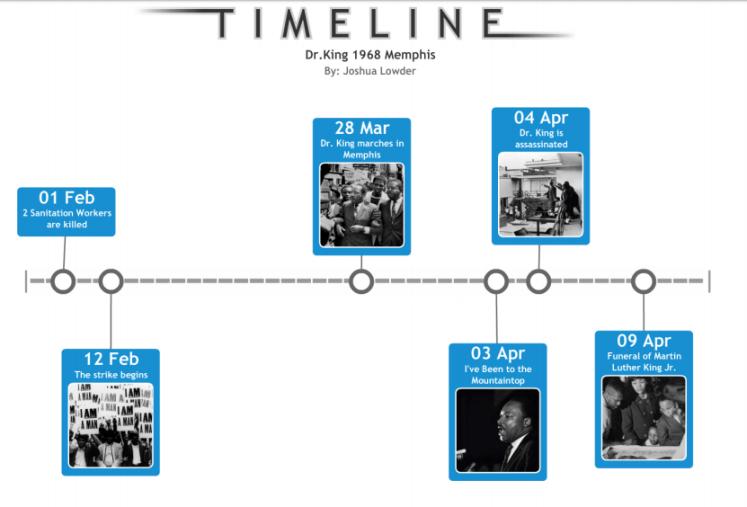
In the spring of 1968, while preparing for a planned march to Washington to lobby Congress on behalf of the poor, King and other SCLC members were called to Memphis, Tennessee to support and aid to support a sanitation workers’ strike.
In his speech, King seemed to foreshadow his own untimely passing, or at least to strike a particularly reflective note, ending with these now-historic words:
“I’ve seen the promised land. I may not get there with you. But I want you to know tonight, that we, as a people, will get to the promised land. And I’m happy tonight. I’m not worried about anything. I’m not fearing any man. Mine eyes have seen the glory of the coming of the Lord.”
Attorney Benjamin Crump, a civil rights attorney mentioned these critical points for people to take away from the speech:
“I was born one year after his assassination but I remember his Mountaintop speech and how he spoke from the heart,” Crump said. “Just like Dr. King, I try to use my platform as a civil rights lawyer to help the least of these.
On April 4, 1968, just around 6 p.m. the following day, King was standing on the second-floor balcony of the Lorraine Motel, where he and his associates were staying, As they were standing suddenly a sniper’s bullet struck him in the neck. He was rushed to a hospital, where he was pronounced dead about an hour later, at the age of 39.
In an interview, Darryl Steele Sr., the son of the late Reverend C.K. Steele, who was close friends with Dr. King reflects on that day 50 years ago.
“My Dad was the Tallahassee civil rights leader such as Martin was nationwide they both led the bus boycotts our families go back to when they were both in college at Morehouse,” Steele said. ” We were all together when we got the news, I couldn’t have been no more than 12 I just had turn 12 two days before that and it was one of the most impressive moments in my life because I realized just how close the two of our families were and it was one of the saddest time I’ve seen my Mom and my Dad.”
In an interview Reverend Don Tolliver talks about Dr. Kings and what it was like during that time in America:
“My thoughts are it was a monuments event that occurred a little over 50 years ago,” Tolliver said. “It was a tragic event for the King family but at the same time I think the continuance of the country at the African-Americans were worth three-fifths of a person, voting right was just being established and it is disheartening to deal with aspects and issues preventing to a person skin and not have the same rights as others.”
In conclusion, in 1983 President Ronald Reagan signed the King holiday bill into law in 1983. Reflecting on what transpired 50 years ago we have made great progress but still, have a tough road ahead of us if people do not vote.
![IMG_0752[1]](https://joshualowder.com/wp-content/uploads/2018/04/img_07521-e1524891819217.png?w=748)
https://readymag.com/u48179091/1046292/
 Joshua Lowder